 Mila – Quebec AI Institute
 Université de Montréal
 Canada CIFAR AI Chair
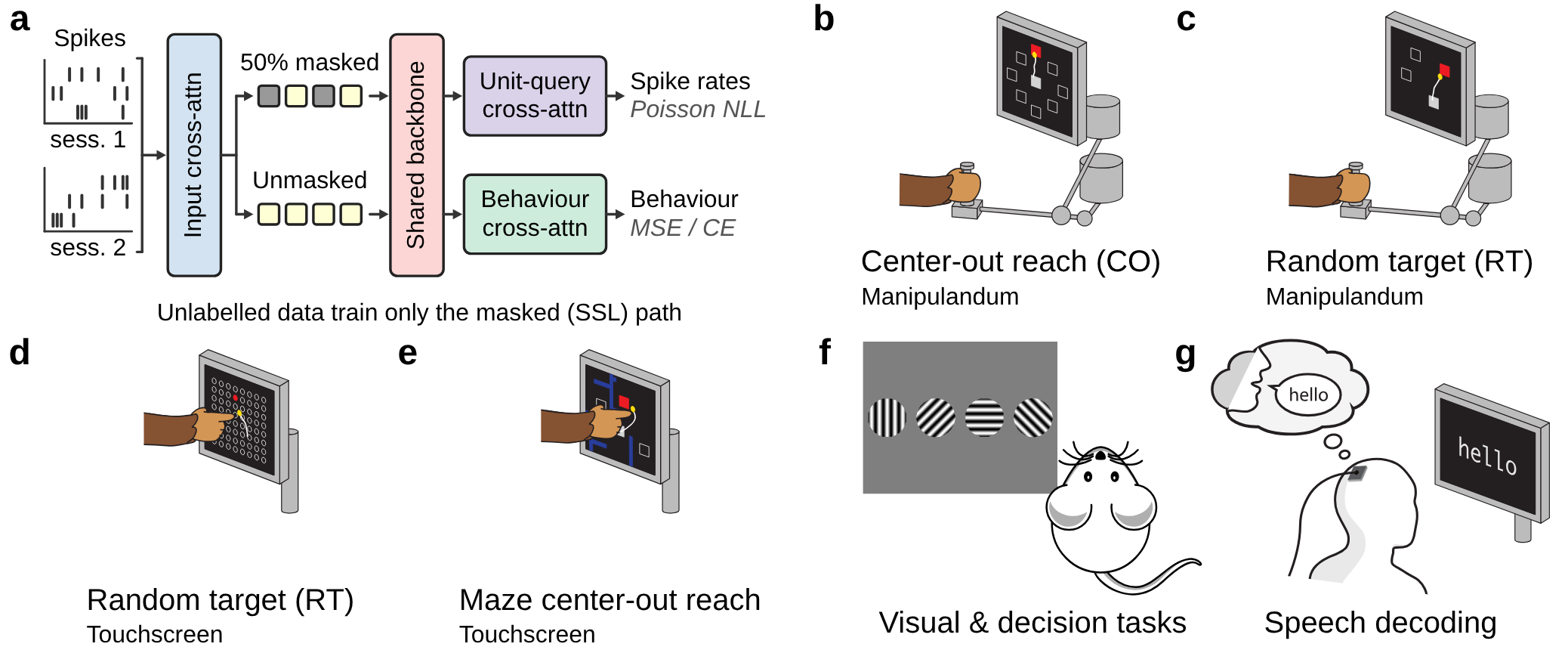
Spike-tokenizing decoders like POYO and POSSM set the state of the art, but they only learn from recordings that come with behavioural labels. MOJO adds a masked-autoencoding objective that trains jointly with the supervised one, so the same model can also learn from the large amount of unlabelled neural data that labs already have.
SSL for spike tokens
Masked autoencoding on the latents rather than the sparse, irregular spike tokens, so it fits any POYO-family backbone (Transformer or SSM) without changing how spikes are tokenized.
Better decoding, fewer labels
Gains on monkey reaching, mouse vision, mouse decision-making and human ECoG, and the largest gains when labels are scarce, as in few-shot finetuning to a new session.
Unit embeddings that know their neuron
Embeddings encode each neuron's firing statistics and even its brain region, information the model never receives during training.
Two pathways, one model
Each spike becomes a token (unit ID + exact timestamp). Input cross-attention compresses each 20 ms chunk into a few latent tokens. The latents then take two passes through a shared backbone: once intact for the supervised (SL) behaviour readout, and once with about half of the time chunks swapped for a learnable mask token for the self-supervised (SSL) pathway, which must predict the spike counts of every unit in the masked chunks. Unlabelled data simply skips the SL loss.
← swipe to see the full timeline →
Illustration with synthetic spikes. Click any time chunk to toggle its mask. Because input cross-attention is local to each chunk, masking a chunk removes all of its spiking information from the SSL pathway.
Mask latents, not spikes
Spike tokens are sparse and irregular, so a "missing" token is ambiguous. Masking whole chunks of latents (p = 0.5, Bernoulli per chunk) avoids this, and decoding is robust from p = 0.02 to 0.9.
Unit queries
The SSL head decodes rates with a query built from a unit's embedding plus a time-bin timestamp, which pushes every unit embedding to capture that neuron's firing pattern.
Joint, not two-stage
LMOJO = LSSL + LSL. Pretraining yields a ready behavioural readout, and the SL loss keeps the representations task-relevant.
Cheap
Encoder and backbone are shared, so per-epoch training time rises only from 220 s to 246 s with a GRU backbone.
Why train jointly?
Finetuning R² on an unseen monkey (T), by how the POGRU model was pretrained. Table 16.
SSL alone, without a single label, already beats training from scratch, and almost matches SL pretraining. Training both objectives together works best.
Every backbone decodes better with MOJO
Pretrained on five public monkey reaching datasets, then adapted to held-out sessions of a seen monkey and to an entirely new monkey. Full finetuning (FT) updates all weights. Unit identification (UI) updates only the unit and session embeddings (<18K parameters).
Behavioural decoding R² on held-out sessions
Mean over sessions. Each line links a supervised backbone to the same backbone trained with MOJO. Table 1.
Show data table
On the hardest set (new monkey, random targets), UI with MOJO-POSSM updates fewer than 18K parameters and matches a fully finetuned supervised POSSM (>7.6M parameters). Much of MOJO's advantage lives in its embeddings.
Few labels? Use the rest of the session anyway
Finetuning on a new monkey with only k labelled trials. MOJO can also use the remaining 32 − k trials without labels: the SSL objective shapes the new session's unit embeddings, which are learned from scratch.
Few-shot finetuning, new monkey T (random targets)
Show data table
Pretraining with fewer labels
Only a fraction of the Perich et al. pretraining data keeps its labels. Test R² on held-out pretraining data, mean of 3 seeds. Fig. 2b.
Show data table
Averaged over the six sessions, MOJO with unlabelled trials reaches 68.6%, 79.4%, 86.6% and 93.9% of its 32-shot performance with 2, 4, 8 and 16 labels. It needs about 4, 11 and 18 labelled trials to reach 80%, 90% and 95%, versus about 8, 15 and 26 for POGRU.
Unit embeddings learn what each neuron is
Every neuron is just an integer ID mapped to a learnable embedding. No brain region, electrode, or subject information is given. Because the SSL head predicts each unit's spike counts from its embedding, MOJO's embeddings end up capturing far more about the neuron than purely supervised ones do. We test this with linear probes.
Linear probes on monkey unit embeddings
Classification accuracy (%) for brain region and subject, mean of 5 seeds. Dashed tick: chance. Table 13.
Show data table
Single-neuron firing statistics
Leave-one-session-out ridge probes on 34,606 mouse neurons (50 Allen sessions). Probe R², mean over held-out sessions. Fig. 3 & 7.
Show data table
Brain region from embeddings alone
One linear classifier across all mice, MOJO-POYO-L (J). Row-normalized, mean of 5 seeds. Hover a cell. Fig. 4a–b.
Most errors fall between neighbouring or functionally related regions, such as DG↔CA1, LP↔LGd, and among the visual areas.
More (and stranger) unlabelled data helps
Allen Visual Coding Neuropixels: 58 sessions, multi-region recordings across visual cortex, thalamus and hippocampus. Variants marked (A) also pretrain on unlabelled periods (other stimuli, no stimulus), and (J) also include all the monkey reaching data.
Natural-scene classification on held-out sessions
Show data table
Monkey data speeds up learning in mice
Natural-scene validation accuracy during pretraining. App. E.5.
After 10 epochs: 33% with prior monkey pretraining vs. 2% without. Both converge to a similar ceiling, so monkey data mainly speeds up convergence and improves the embeddings (above). Performance on the monkey tasks is maintained.
Spontaneous activity is as good as task data
5-shot, 8-way grating-orientation accuracy on a held-out mouse session, finetuned with extra unlabelled activity from that session. App. E.4.
IBL decision-making (repeated-site Neuropixels)
Choice and block prior: balanced accuracy. Wheel speed and whisker motion energy: R². Mean ± SD over 10 held-out sessions. * p < 0.05 vs. POYO. Table 3.
Show data table
Same recipe, human ECoG
256-channel high-density ECoG over ventral sensorimotor cortex while four participants spoke consonant–vowel syllables. High-gamma is patched into 20 ms tokens, and the model jointly predicts the vowel, the consonant and the full syllable.
Speech decoding accuracy
Mean ± SD over 3 seeds, averaged over 4 participants. Dashed line: chance (1/3, 1/19, 1/57). ** p < 0.01, MOJO-POYO vs. POYO. Fig. 4c.
Show data table
MOJO beats supervised POYO on all three tasks, with a 47% relative gain on syllables, and is statistically on par with Du-IN, a model designed for intracranial recordings, even though MOJO was built for spikes.
Takeaways & limitations
What we learned
- Spike-tokenizing decoders can now use unlabelled neural data, both during pretraining and when adapting to a new session.
- Most of the benefit flows through the unit embeddings, which explains MOJO's strong showing with unit identification.
- The approach carries over to continuous signals (ECoG), which points towards multi-modal neuro-foundation models.
Where it falls short
- Like other masked models, MOJO is data-hungry: trained on a single session it can underperform pure SL.
- Unit embeddings are relearned for every new session, so extra unlabelled pretraining data alone gives mixed downstream gains. Unlabelled data from the new session helps consistently.
- Masking is temporal only. Spatial objectives, such as predicting unseen neurons or regions, are a natural next step.
BibTeX
@inproceedings{mao2026mojo,
  title     = {Leveraging unlabelled data for generalizable neural population decoding},
  author    = {Ximeng Mao and Nanda H. Krishna and Avery Hee-Woon Ryoo and Matthew G. Perich and Guillaume Lajoie},
  booktitle = {The Fortieth Annual Conference on Neural Information Processing Systems},
  year      = {2026},
  url       = {https://arxiv.org/abs/2607.14086}
}
@misc{mao2026mojo,
title = {Leveraging unlabelled data for generalizable neural population decoding},
author = {Ximeng Mao and Nanda H. Krishna and Avery Hee-Woon Ryoo and Matthew G. Perich and Guillaume Lajoie},
year = {2026},
eprint = {2607.14086},
archivePrefix = {arXiv},
primaryClass = {cs.LG},
url = {https://arxiv.org/abs/2607.14086}
}